Tesamorelin Research Peptide 20 mg
For research use only. Not for human consumption.20 mg
$149.00
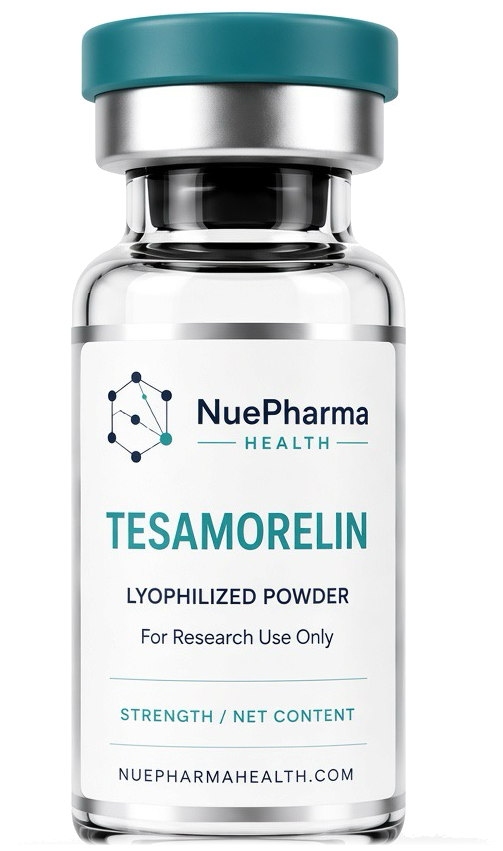
GHRH(1-44) analog. CAS 218949-48-5.
A growth-hormone-releasing-hormone (GHRH) analogue acting on the GH/IGF-1 axis. An approved drug exists for one narrow HIV-related indication; NuePharma's material is unapproved and research-use only.
Ordering is closed. This product becomes purchasable when a lot for it has been released and its certificate published.
Single-vial price. Volume pricing begins at 2 vials.
One unit is one vial. The per-vial price changes at 2, 6, 25, 50 and 100 vials; between those points it does not change.
An inquiry is a question about availability, never an order.
Below 100 vials the price is published, not quoted. The band your quantity falls into is applied automatically at checkout.
Research Use Only Purchasers must be 21+
Release requires
- Certificate of analysisNone on fileSigned by a named, independent, contactable laboratory.Why independence matters
- ChromatogramNone on fileFull trace as issued, not a redrawn summary.How a trace is read
- Identity confirmationNone on fileMethod and result as reported, never as summarised.Identity is not purity
- Lot recordNone on fileOne permanent address per lot, kept whatever the outcome.What a lot record holds
No purity figure, identity result, laboratory name or test date appears anywhere on this page, because none has been recorded for this product.
Description
44-residue GHRH analog with a trans-3-hexenoyl group at the N-terminus. CAS 218949-48-5. Formula C221H366N72O67S. Molecular weight 5,135.9 Da. Supplied as lyophilized powder, 20 mg per vial.
Learn the science Mechanism and pathway for Tesamorelin
A hormone-release pathway, one step at a time
Tesamorelin is a synthetic analogue of a hormone the body already makes. This is the sequence that follows, one step at a time.
Tesamorelin
What you're seeing
A laboratory-made copy of growth-hormone-releasing hormone (GHRH), the signal the brain normally sends to the pituitary gland.
Scientific detail
A synthetic analogue of growth hormone-releasing factor. The FDA labeling for the approved pharmaceutical product states it binds and stimulates human GRF receptors with similar potency to the endogenous hormone. An analogue is a modified copy of a natural molecule, built to behave like it.
Where this happens
What you're seeing
The pituitary is a small gland at the base of the brain. The signal the brain sends acts there, on the cells that make growth hormone.
Scientific detail
The cited labeling states that GHRH acts on pituitary somatotroph cells to stimulate the synthesis and pulsatile release of endogenous growth hormone, and the LiverTox entry states that tesamorelin activates GHRH receptors in the pituitary. The figure is a simplified orientation drawing of that location — not an anatomical illustration, and not to scale.
GHRH receptor
What you're seeing
The receiving point on the cells of the pituitary gland. Binding it is the step that starts everything downstream.
Scientific detail
The FDA labeling for the approved pharmaceutical product states that tesamorelin binds and stimulates human GRF receptors with potency similar to the endogenous hormone. The receptor sits on pituitary somatotroph cells; nothing further in this sequence happens without this step.
Pituitary signaling
What you're seeing
Once the receptor is activated, the pituitary cell makes growth hormone and releases it in bursts rather than at a constant level.
Scientific detail
GHRH acts on pituitary somatotroph cells to stimulate the synthesis and pulsatile release of endogenous growth hormone. "Pulsatile" matters: the pathway works in bursts rather than a steady level, which is part of why it is studied as a release pathway rather than a hormone replacement.
Growth hormone
What you're seeing
The hormone the pituitary releases in response. It travels in the blood and acts on many different tissues.
Scientific detail
Growth hormone interacts with receptors on a range of target cells, including hepatocytes, myocytes, osteoblasts, chondrocytes and adipocytes. Some, but not all, of its effects are mediated by IGF-1. The labeling reports no clinically significant change in other pituitary hormones such as TSH, LH, ACTH or prolactin.
IGF-1
What you're seeing
Insulin-like growth factor 1. Growth hormone prompts the liver to produce it, and it is one of the ways growth hormone has its effects.
Scientific detail
Growth hormone stimulates IGF-1 production in hepatocytes and peripheral tissues; the labeling reports that tesamorelin increases IGF-1 and IGFBP-3 levels. Together the GH/IGF-1 axis is a well-characterised regulatory pathway. Measuring a change in this axis is not the same as demonstrating a clinical benefit, which is what a trial for a specific indication establishes.
Simplified pathway, drawn for educational purposes. It shows what published research describes about the molecule. It does not describe a result in a person, and it is not a claim about NuePharma material.
Tesamorelin is the active ingredient in an FDA-approved pharmaceutical product, approved for one specific indication: reduction of excess visceral abdominal fat in adults with HIV-associated lipodystrophy. NuePharma's tesamorelin is an unapproved research-use material. It is not that product, is not manufactured or distributed under that approval, and carries none of its regulatory status.
Lot recordNo lot published yet
No lot published for this product yet. Nothing ships without a certificate.
Keep going
Go deeper into the science.
Discover the compounds, pathways and research systems connected to what you're already exploring.
Related research
-
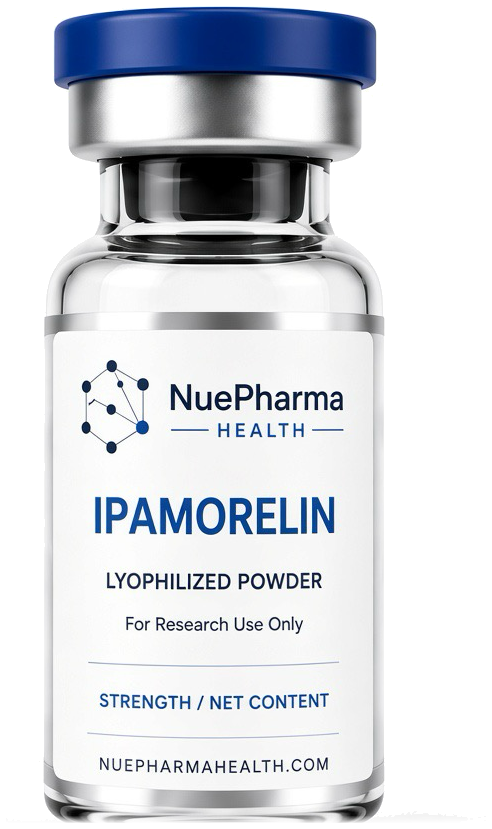
Ipamorelin
For research use only. Not for human consumption.Two receptor routes into growth-hormone release — the GHRH receptor and the ghrelin receptor — studied as separate entry points to the same axis.
Adjacent research pathways
-
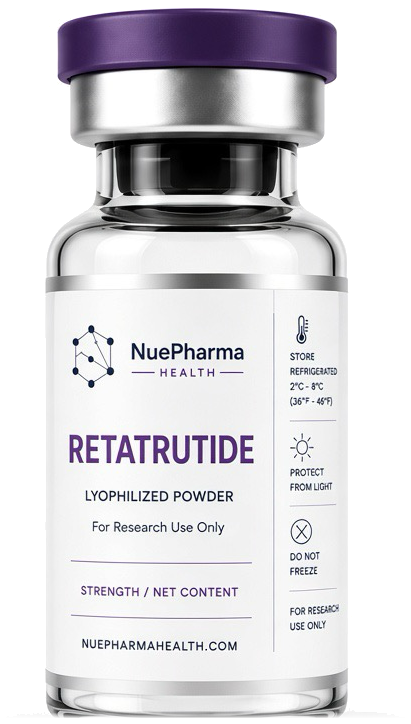
Retatrutide
For research use only. Not for human consumption.Explore incretin and glucagon-receptor research, a separate part of the metabolic and endocrine picture.
Research systems Endocrine signaling Metabolic pathways
These are separate research materials with separate research records. Nothing here suggests combining them, and no connection above is a claim about using more than one.
Why this format
We intentionally selected this vial configuration as a balanced format for laboratory research—substantial enough for practical experimental planning without unnecessarily increasing the quantity contained in an individual vial. Each vial remains individually traceable to its corresponding lot record and supporting documentation.
Stability & storage
Refer to the product’s applicable documentation and labeled storage conditions. NuePharma does not assign generalized post-reconstitution or expiration periods unless supported by product-specific documentation.