Retatrutide
A triple-receptor agonist peptide (GIP, GLP-1, and glucagon receptors), currently investigational and not FDA-approved.
If a product isn’t currently listed, that doesn’t necessarily mean it’s unavailable to us. Our team will review your request and contact you within 24 hours.
Tell us what you are looking for. If it becomes available for research use, we can let you know.
A triple-receptor agonist peptide (GIP, GLP-1, and glucagon receptors), currently investigational and not FDA-approved.
Mechanism
Retatrutide is a single synthetic peptide reported to act at three separate receptors. This is what published research describes at each one.
Step 1 Synthetic peptide · LY3437943
A laboratory-made peptide designed to act on three different receptors at once, rather than one. It is investigational: it has not been approved for any use.
Described in the literature as a triple receptor agonist peptide, developed under the code LY3437943. An agonist is a molecule that binds a receptor and activates it. Acting at three receptors with one molecule is the property being studied here; single-receptor and dual-receptor agonists are separate, earlier classes of compound.
Terminology What are receptors, ligands, agonists, and antagonists? What is a peptide, and how is it different from a protein?
Step 2 In a cell membrane
A receptor is not free-floating. It spans the wall of a cell, so that something arriving on the outside can start a signal on the inside. All three receptors here are built that way.
GLP-1R, GIPR and the glucagon receptor are G-protein-coupled receptors with a seven-transmembrane architecture: seven segments crossing the membrane, an outward-facing side that binds, and an inward-facing side that signals. That shared architecture is why one molecule can be studied at all three. The drawing is a schematic of that arrangement, not a resolved structure.
Terminology What are receptors, ligands, agonists, and antagonists?
Step 3 GLP-1 receptor
The receptor for GLP-1, a gut hormone involved in blood-sugar regulation and appetite signaling. It is the best-established of the three, and the mechanism behind an existing, widely studied drug class.
Glucagon-like peptide-1 receptor. In the published discovery pharmacology, in-vitro activity at this receptor was reported as balanced with activity at the glucagon receptor. Reduced calorie intake in preclinical models was attributed to GLP-1 and GIP receptor activity.
Terminology What are receptors, ligands, agonists, and antagonists?
Step 4 GIP receptor
The receptor for GIP, another gut hormone released after eating. It is being studied for effects that may add to, or differ from, GLP-1 receptor activity.
Glucose-dependent insulinotropic polypeptide receptor. The discovery pharmacology reported greater in-vitro activity at this receptor than at the other two. Whether combined GIP and GLP-1 receptor activity is meaningfully different from GLP-1 receptor activity alone is an active research question, not a settled one.
Terminology What are receptors, ligands, agonists, and antagonists?
Step 5 Glucagon receptor
The receptor for glucagon, a hormone involved in how the body uses stored energy. It is the component that distinguishes this compound from dual-receptor agonists.
In the cited preclinical work, glucagon-receptor activity was associated with increased energy expenditure, reported alongside the reduced calorie intake attributed to the other two receptors. This describes what that study measured in its models. It is not a predicted result in a person.
Terminology What are receptors, ligands, agonists, and antagonists? How does research move from a lab bench to a clinical trial, and why do results sometimes not translate?
Step 6 What is under study
The research question is whether activating all three receptors with one molecule behaves differently from activating one or two. That question is still being answered in clinical trials.
A phase 1b trial in adults with type 2 diabetes and a phase 2 trial in adults with obesity have been published, and a phase 3 program is registered on ClinicalTrials.gov. A published trial result is evidence; it is not the same thing as an approved use, which follows full regulatory review.
Terminology How does research move from a lab bench to a clinical trial, and why do results sometimes not translate?
Source LY3437943 in people with type 2 diabetes: a phase 1b multiple-ascending-dose trial (The Lancet, 2022) Triple-Hormone-Receptor Agonist Retatrutide for Obesity — a phase 2 trial (2023) TRIUMPH-1 phase 3 study record, NCT05929066 (ClinicalTrials.gov)
That is the mechanism in brief. The rest of this page is the detail.
View Retatrutide Verify a lotKeep going
Discover the compounds, pathways and research systems connected to what you're already exploring.
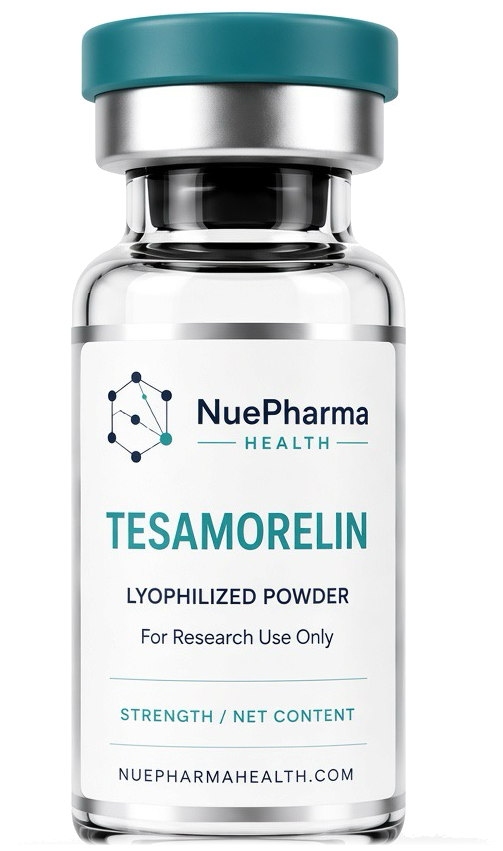
Tesamorelin
For research use only. Not for human consumption.Explore a different side of metabolic and endocrine research through the GHRH and GH/IGF-1 axis.
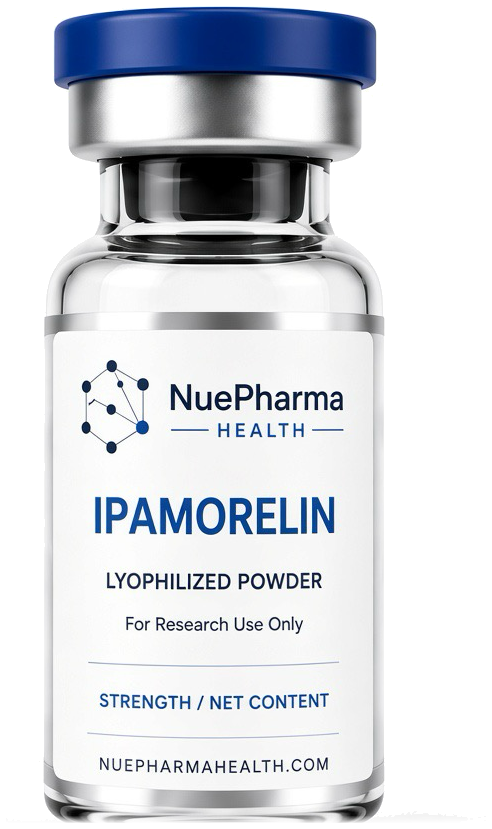
Ipamorelin
For research use only. Not for human consumption.Explore ghrelin-receptor signaling and growth-hormone release in a separate but related research context.
Research systems Metabolic pathways Endocrine signaling
These are separate research materials with separate research records. Nothing here suggests combining them, and no connection above is a claim about using more than one.
Simplified pathway, drawn for educational purposes. It shows what published research describes about the molecule. It does not describe a result in a person, and it is not a claim about NuePharma material.
Preclinical research Published
The discovery pharmacology characterised activity at all three receptors in vitro and studied the compound in animal models, where glucagon-receptor activity was associated with increased energy expenditure alongside reduced calorie intake attributed to the other two receptors.
Human research Published
A phase 1b multiple-ascending-dose trial in adults with type 2 diabetes and a phase 2 trial in adults with obesity have both been published, and a phase 3 program is registered and under way.
Source LY3437943 in people with type 2 diabetes: a phase 1b multiple-ascending-dose trial (The Lancet, 2022) Triple-Hormone-Receptor Agonist Retatrutide for Obesity — a phase 2 trial (2023) TRIUMPH-1 phase 3 study record, NCT05929066 (ClinicalTrials.gov)
Regulatory status Not approved
Investigational. Not approved by the FDA for any indication, in any population. A published trial result is evidence; approval follows full regulatory review, and that has not happened.
Source TRIUMPH-1 phase 3 study record, NCT05929066 (ClinicalTrials.gov)
Every unit of this compound traces to a lot, and every lot to its own analytical record.
Can't find your answer?