Tesamorelin
A GHRH-analogue peptide. Tesamorelin is the active ingredient in an FDA-approved pharmaceutical product for a specific indication; NuePharma's material is a separate, unapproved research-use item.
If a product isn’t currently listed, that doesn’t necessarily mean it’s unavailable to us. Our team will review your request and contact you within 24 hours.
Tell us what you are looking for. If it becomes available for research use, we can let you know.
A GHRH-analogue peptide. Tesamorelin is the active ingredient in an FDA-approved pharmaceutical product for a specific indication; NuePharma's material is a separate, unapproved research-use item.
Mechanism
Tesamorelin is a synthetic analogue of a hormone the body already makes. This is the sequence that follows, one step at a time.
Step 1 GHRH analogue
A laboratory-made copy of growth-hormone-releasing hormone (GHRH), the signal the brain normally sends to the pituitary gland.
A synthetic analogue of growth hormone-releasing factor. The FDA labeling for the approved pharmaceutical product states it binds and stimulates human GRF receptors with similar potency to the endogenous hormone. An analogue is a modified copy of a natural molecule, built to behave like it.
Terminology What is a peptide, and how is it different from a protein? What are receptors, ligands, agonists, and antagonists?
Source EGRIFTA WR (tesamorelin) prescribing information — U.S. Food & Drug Administration Tesamorelin — LiverTox, NCBI Bookshelf (National Institutes of Health)
Step 2 The pituitary gland
The pituitary is a small gland at the base of the brain. The signal the brain sends acts there, on the cells that make growth hormone.
The cited labeling states that GHRH acts on pituitary somatotroph cells to stimulate the synthesis and pulsatile release of endogenous growth hormone, and the LiverTox entry states that tesamorelin activates GHRH receptors in the pituitary. The figure is a simplified orientation drawing of that location — not an anatomical illustration, and not to scale.
Terminology What are receptors, ligands, agonists, and antagonists?
Source EGRIFTA WR (tesamorelin) prescribing information — U.S. Food & Drug Administration Tesamorelin — LiverTox, NCBI Bookshelf (National Institutes of Health)
Step 3 Pituitary somatotrophs
The receiving point on the cells of the pituitary gland. Binding it is the step that starts everything downstream.
The FDA labeling for the approved pharmaceutical product states that tesamorelin binds and stimulates human GRF receptors with potency similar to the endogenous hormone. The receptor sits on pituitary somatotroph cells; nothing further in this sequence happens without this step.
Terminology What are receptors, ligands, agonists, and antagonists?
Source EGRIFTA WR (tesamorelin) prescribing information — U.S. Food & Drug Administration Tesamorelin — LiverTox, NCBI Bookshelf (National Institutes of Health)
Step 4 Inside the somatotroph
Once the receptor is activated, the pituitary cell makes growth hormone and releases it in bursts rather than at a constant level.
GHRH acts on pituitary somatotroph cells to stimulate the synthesis and pulsatile release of endogenous growth hormone. "Pulsatile" matters: the pathway works in bursts rather than a steady level, which is part of why it is studied as a release pathway rather than a hormone replacement.
Terminology What are receptors, ligands, agonists, and antagonists?
Source EGRIFTA WR (tesamorelin) prescribing information — U.S. Food & Drug Administration Tesamorelin — LiverTox, NCBI Bookshelf (National Institutes of Health)
Step 5 Released by the pituitary
The hormone the pituitary releases in response. It travels in the blood and acts on many different tissues.
Growth hormone interacts with receptors on a range of target cells, including hepatocytes, myocytes, osteoblasts, chondrocytes and adipocytes. Some, but not all, of its effects are mediated by IGF-1. The labeling reports no clinically significant change in other pituitary hormones such as TSH, LH, ACTH or prolactin.
Terminology What do pharmacology, pharmacokinetics, and pharmacodynamics mean?
Source EGRIFTA WR (tesamorelin) prescribing information — U.S. Food & Drug Administration Tesamorelin — LiverTox, NCBI Bookshelf (National Institutes of Health)
Step 6 Produced largely in the liver
Insulin-like growth factor 1. Growth hormone prompts the liver to produce it, and it is one of the ways growth hormone has its effects.
Growth hormone stimulates IGF-1 production in hepatocytes and peripheral tissues; the labeling reports that tesamorelin increases IGF-1 and IGFBP-3 levels. Together the GH/IGF-1 axis is a well-characterised regulatory pathway. Measuring a change in this axis is not the same as demonstrating a clinical benefit, which is what a trial for a specific indication establishes.
Terminology What do pharmacology, pharmacokinetics, and pharmacodynamics mean?
Source EGRIFTA WR (tesamorelin) prescribing information — U.S. Food & Drug Administration Tesamorelin — LiverTox, NCBI Bookshelf (National Institutes of Health)
That is the mechanism in brief. The rest of this page is the detail.
View Tesamorelin Verify a lotKeep going
Discover the compounds, pathways and research systems connected to what you're already exploring.
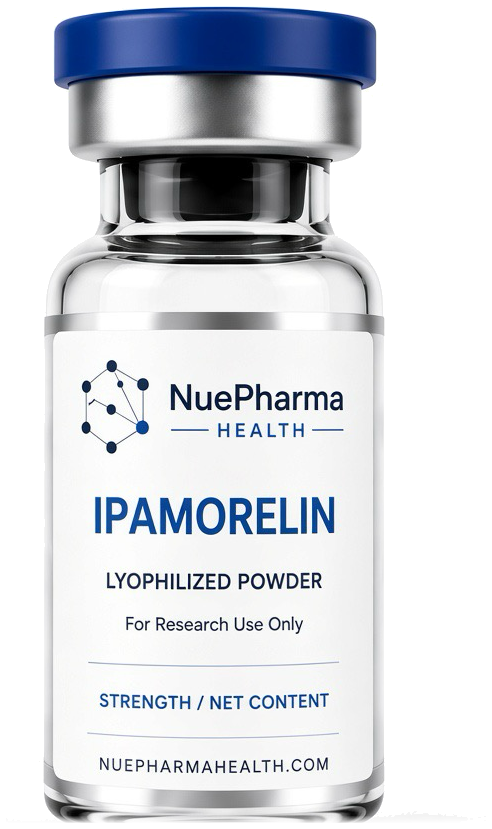
Ipamorelin
For research use only. Not for human consumption.Two receptor routes into growth-hormone release — the GHRH receptor and the ghrelin receptor — studied as separate entry points to the same axis.
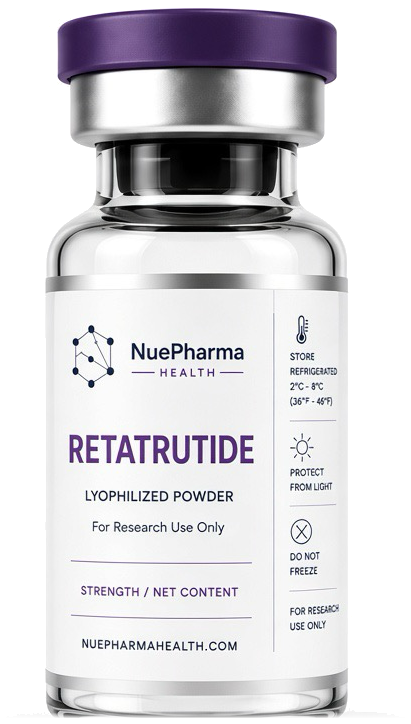
Retatrutide
For research use only. Not for human consumption.Explore incretin and glucagon-receptor research, a separate part of the metabolic and endocrine picture.
Research systems Endocrine signaling Metabolic pathways
These are separate research materials with separate research records. Nothing here suggests combining them, and no connection above is a claim about using more than one.
Simplified pathway, drawn for educational purposes. It shows what published research describes about the molecule. It does not describe a result in a person, and it is not a claim about NuePharma material.
Preclinical research Published
The receptor pharmacology is characterised in the approved product's own labeling: tesamorelin binds and stimulates human GRF receptors with potency similar to the hormone the body makes, and the GH/IGF-1 axis it feeds into is a long-established pathway.
Source EGRIFTA WR (tesamorelin) prescribing information — U.S. Food & Drug Administration Tesamorelin — LiverTox, NCBI Bookshelf (National Institutes of Health)
Human research Published
Clinical trials in adults with HIV-associated lipodystrophy supported the original approval, and the labeling reports increases in IGF-1 and IGFBP-3 without clinically significant change in other pituitary hormones. Research outside that specific population is a separate question from what those trials established.
Source EGRIFTA WR (tesamorelin) prescribing information — U.S. Food & Drug Administration EGRIFTA SV (tesamorelin for injection) prescribing information — U.S. Food & Drug Administration FDA approval letter, Egrifta (tesamorelin), 2010
Regulatory status Approved, separately
An FDA-approved pharmaceutical product containing tesamorelin exists, for one narrow indication. NuePharma's material is not that product and carries none of that approval. See the note below.
Source EGRIFTA WR (tesamorelin) prescribing information — U.S. Food & Drug Administration FDA approval letter, Egrifta (tesamorelin), 2010
Tesamorelin is the active ingredient in an FDA-approved pharmaceutical product, approved for one specific indication: reduction of excess visceral abdominal fat in adults with HIV-associated lipodystrophy. NuePharma's tesamorelin is an unapproved research-use material. It is not that product, is not manufactured or distributed under that approval, and carries none of its regulatory status.
Every unit of this compound traces to a lot, and every lot to its own analytical record.
Can't find your answer?